
A LIVERPOOL MINI-SERIES
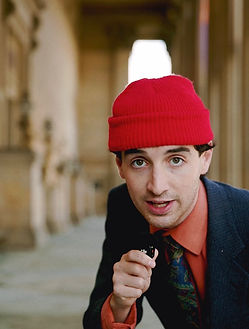
WHO WAS THE UNCOMMERCIAL TRAVELLER?
A tribute to Dickens By Campbell Wallace
A five-part journey in the footsteps of Charles Dickens, through the institutions, performance halls and hidden histories of Liverpool.
The Uncommercial Traveller was a collection of literary sketches and hard-hitting journalism pieces that Charles Dickens published in his weekly journal, All the Year Round, starting in 1860.
Dickens invented a fictional alter-ego, the "Traveller" who traveled not to sell material goods (like a commercial traveler or salesman), but to travel in human interest. He used this persona to wander into the dark, forgotten corners of society, blending sharp investigative reporting with his trademark wit to expose social inequalities and eccentric characters. Outside of London, was Liverpool was his ultimate muse? He would undergo these investigations for inspiration or characters in his books.

"He travelled not to sell material goods, but in
pursuit of human interest."
Liverpool actor Campbell Wallace follows in the footsteps of Charles Dickens, exploring the places, people and stories that connected the writer to Liverpool.
Across five short films, Campbell visits Brownlow Hill Workhouse, the Liverpool Mechanics' Institute, the Philharmonic Hall, the Liverpool Bridewell and St George's Hall. He investigates Dickens' journalism, including Poor Mercantile Jack, and retraces the history of the author's celebrated public performances in the city.
Meeting local people along the way, Campbell uncovers a Liverpool of workhouses, schools, prisons, concert halls and extraordinary characters. The result is a lively journey through literary history that asks whether Liverpool, beyond London, became Dickens' greatest source of inspiration.
Follow the Traveller
A Journey through workhouses, schools, concert halls, prisons and a civic palace as Liverpool's Dickensian history emerges from the today's modern city.

Episode One - Brownlow Hill Workhouse
The dark history behind Liverpool's Metropolitan
Cathedral
Liverpool Metropolitan Cathedral - affectionately known as "Paddy's Wigwam" - is one of the city's most distinctive landmarks. Designed by Sir Frederick Gibberd and opened in 1967, its circular form and soaring crown make it unlike almost any other cathedral in Britain.
Yet the story of this site is as remarkable as the building itself.
Beneath the modern cathedral lies the enormous crypt designed by architect Sir Edwin Lutyens. His original vision for Liverpool's cathedral was monumental: its proposed dome would have measured 168 feet in diameter, exceeding that of St Peter's Basilica in Rome. However, as the estimated cost rose from approximately £3 million to £27 million, the ambitious scheme was abandoned. The crypt remains as a striking fragment of the cathedral that might have been.
There is, however, an older and darker history beneath both designs.
When Charles Dickens visited Liverpool in 1860, there was no cathedral on Brownlow Hill. The site was occupied by Brownlow Hill Workhouse, an enormous institution housing some of the city's poorest and most vulnerable people.
It was also the home of the Liverpool Infirmary. Dickens visited the sick soldiers who were brought here upon their return from India aboard the Great Tasmania. Many were desperately ill, and the conditions he encountered left him appalled. He later recorded the experience in The Uncommercial Traveller, in an article titled The Great Tasmania's Cargo.
Dickens Wrote "The spectacle of the soldiers in the hospital beds of that Liverpool workhouse, was so shocking and so shameful, that as an Englishman I blush to remember it ."
Today, Liverpool Metropolitan Cathedral stands as a bold symbol of faith and modern architecture. Yet beneath it lies the memory of an institution Dickens believed the nation should be ashamed of. Here, as throughout his journeys, Dickens used his position to report on behalf of ordinary people - entering places many preferred not to see and recording lives that might otherwise have been forgotten.
Episode Two - The Liverpool Mechanics' Institute
Critics thought the mechanics' institutes were dangerous, revolutionary establishments
Today, the building is home to LIPA - the Liverpool Institute for Performing Arts, known affectionately to some students as "the Innie." Its studios, theatres and rehearsal rooms are devoted to actors, dancers, musicians and other creative practitioners.
The building's association with education and personal development, however, began long before LIPA arrived. It originally opened in 1837 as the Liverpool Mechanics' Institution. Established to provide educational opportunities for working people, it offered lectures, classes and access to a library and museum. By 1844, the institution had attracted more than 3,000 members, while its library contained approximately 11,000 volumes.

On 26 February that year, a particularly distinguished guest arrived to preside over the institution's annual soiree: Charles Dickens. Dickens was welcomed by an audience of approximately 1,200 people. In his address, he spoke passionately about the importance of education and its power to improve not only individual lives, but society as a whole. He had a particular affection for mechanics' institutions and other places that made knowledge available to people who might otherwise have been denied it.
The Mantra of these institutions was
"Knowledge is Power"
Dickens rote "Every man who has felt the advantages of, or has received improvement in this place, carries its benefits into the society in which he moves, and puts them out at compound interest."
For Dickens, education was an investment whose benefits spread far beyond the classroom. A person who gained knowledge and confidence would carry those advantages into the workplace, the family and the wider community. The value of education would therefore continue to multiply - or, as he put it, accumulate at "compound interest."
The institution's identity continued to evolve. It later became the Liverpool Institute and School of Arts, and the building now houses LIPA. Its students and subjects have changed, and the lecture rooms of the Victorian Mechanics' Institution have given way to contemporary spaces for performance and creative training.
Yet the principle Dickens celebrated here has survived remarkably well. Nearly two centuries later, the building remains dedicated to people learning, creating and improving themselves. The actors have changed. The students have changed. Even the name has changed. But the belief that education can transform both individuals and society continues to define this historic Liverpool institution.